Ethereum staking rewards cut could help ETH price, Grayscale says
Staking rewards could be reduced under a new model being discussed by the network's community, but the change may support ETH price over time, Grayscale says.

Ethereum may eventually cut staking rewards if researchers decide the network is paying too much new ETH to attract validators.
Grayscale, a crypto manager with over $30 billion in assets under management, said in a Tuesday blog post, May 12, that the Ethereum community is considering a reward model that "only incentivizes staking up to a certain point."
Under that model, Ethereum would still reward validators, the people and firms that lock ETH to help secure the network, but rewards would decline once enough ETH is already staked.
As Grayscale head of research Zach Pandl argues, that change would likely cut nominal rewards for stakers, but could still be positive for ETH's price over time because it may slow ETH inflation and strengthen ETH's use as a store of value.
Ethereum weighs new approach
While Pandl didn't name the exact Ethereum proposal or forum discussions, the blog post comes a few weeks after Pintail, an Ethereum researcher, wrote in an April 20 blog post that Ethereum's staking ratio has reached one-third of supply and is still rising.
Pintail
The technical side of the debate is about Ethereum's reward curve, the formula that decides how much ETH validators earn as more ETH gets staked.
As Grayscale suggests, very high staking levels can create "unnecessary dilution" by raising net issuance "without meaningfully increasing network security."
How Ethereum staking works now
Ethereum's supply depends on two forces. New ETH is created as rewards for validators, while part of transaction fees is burned and permanently removed from circulation.
That balance has shifted as more activity has moved to Layer-2 networks, cheaper Ethereum-linked systems that process transactions away from the main chain. Grayscale said that the transition has reduced mainnet fees and token burn, adding that "net issuance has risen."
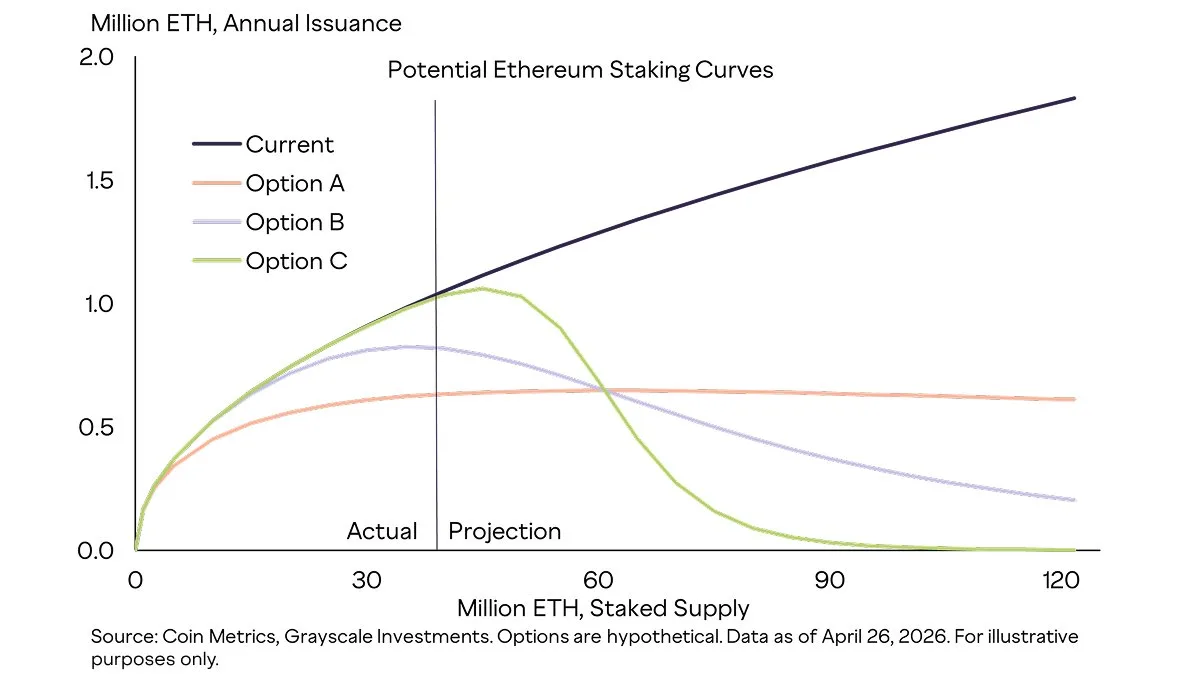
Chart showing potential Ethereum staking curves. Source: Grayscale
Staking has also become easier and more liquid than it was in Ethereum's early staking days. The validator entry queue is currently clear rather than backed up like the 44-day wait seen in October 2025, and Grayscale said exchange-traded products and crypto treasuries can stake ETH too.
Zach Pandl
Data from Staking Rewards, a staking analytics website, shows that Ethereum staking APY is now about 2.84%, roughly 87% lower than the initial 21.6% APR available around the Beacon Chain launch in December 2020, when Ethereum first introduced staking.
Staking rewards could be reduced under a new model being discussed by the network's community, but the change may support ETH price over time, Grayscale says.